
Writing is not producing content.
I'm bored, distracted and angry at myself.

I made it to page 2 of 22 in the latest white paper from a competitor. Surprising because I am the target audience. Highly interested in the category, prefer writing to video, seeking competitive intel, but I got distracted. The language, the pace, the predictability, all stunk of AI. Then I got pissed. I recognize my writing in this as well. Numbing. It’s Muzak. I’m creating it. We’re all creating it. This doesn’t work.
Over the last two years I’ve been integrating generative AI into my business processes and a big part of that is my writing. I use multiple AI models as thinking partners, pressure-testing what I get, mixing and matching like a DJ. But somewhere in that process an over-reliance crept in, using AI to bulk produce once I felt the thinking was sound and then trying to comb myself back into the prose at the end. Voice isn’t a layer you add after the fact. I know this. I’ve been lazy and I’m not happy with it.
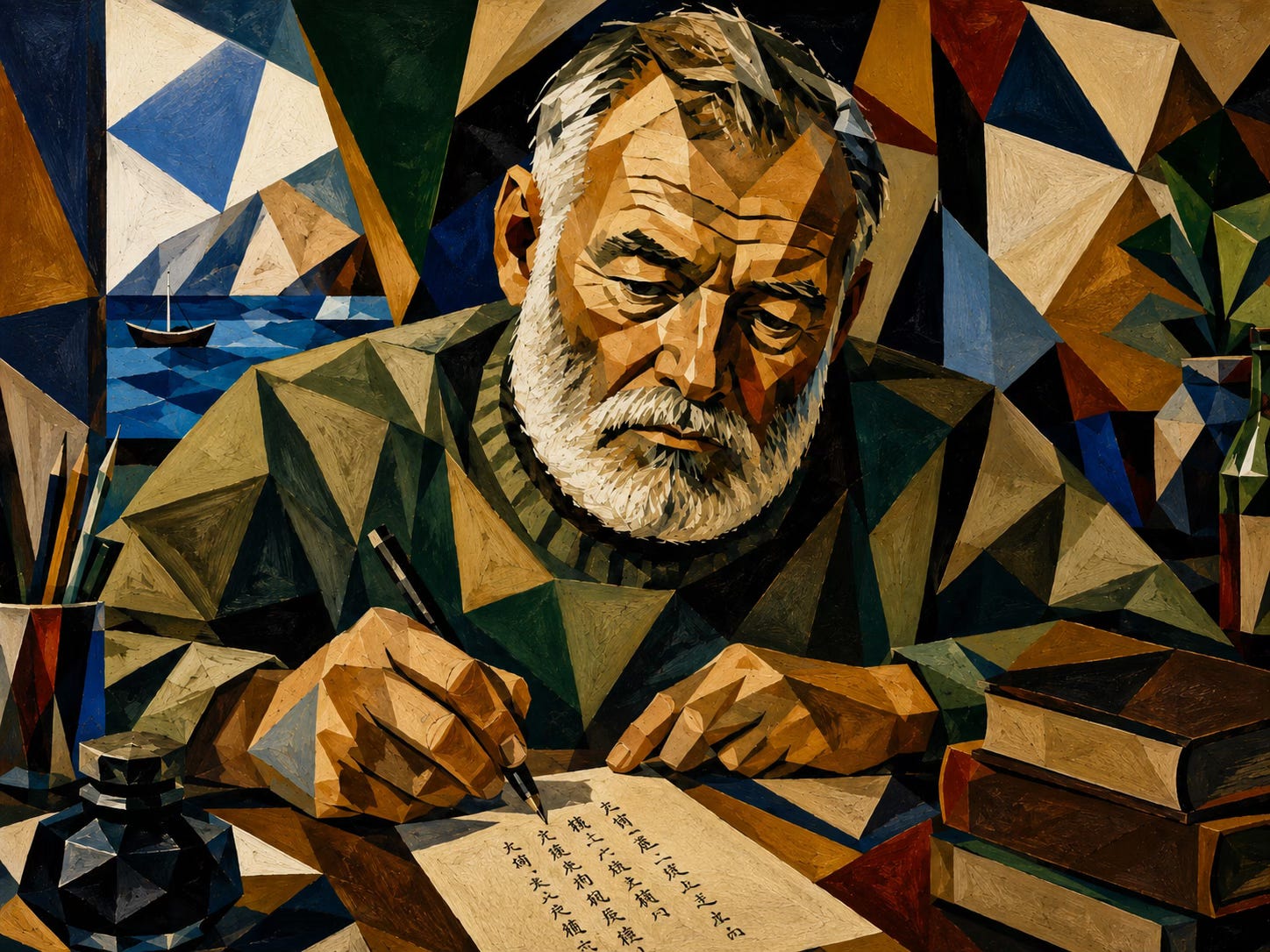
Two writing styles have never left me. Hemingway and haiku. Direct, compressed, every line with a purpose, nothing surviving that doesn’t have to be there. That’s a craft and a discipline and it produces a specific relationship between the writer and the reader that most business writing has never understood.
Hemingway called it the iceberg, the idea that the dignity of what you see comes entirely from what you don’t, that the seven-eighths below the surface is what gives the visible part its meaning and its tension, and that the writer who shows everything destroys the thing they’re trying to make. Carver understood this. So did Chekhov, who could end a story in a place that felt like the middle and leave you wrestling with it for days because the resolution was always underneath the story, not at the end of it. These writers knew exactly who they were writing for, not a demographic, not a buyer persona, an actual person, specific, recognizable, and that precision meant they could skip the scaffolding, the setup, the explanation of what they were about to say, because the reader they had in mind was already with them and didn’t need to be oriented. They trusted that reader the way you trust someone you’ve known a long time, which means they could say less and mean more, could let the gap between the said and the unsaid do the work.
That is where business writing has to go, not as a stylistic preference but as a strategic necessity, and the only way to get there is to know your reader the way Carver knew his, with enough specificity that you feel the permission to leave things out, to end before the conclusion, to put the meaning below the surface and trust that the person you’re writing for will feel the weight of it without the writer pointing at it.
Most business content doesn’t know who it’s writing for. Not really. It knows a category, a title, an industry, a problem set, and so it explains everything, covers every angle, leaves nothing below the surface, because it can’t afford to lose anyone, which means it reaches no one at all.
Business writing isn’t written. It’s produced. The difference matters. Production is a process, inputs in, content out, managed against time and capacity. Writing is a different act entirely and the part that gets cut when the calendar fills is always the hardest part, the compression, the editing down to core, the hours of knowing what to leave out. That takes deep knowledge of the topic, deep knowledge of the reader, not an ICP definition and a style guide but actual proximity to the person you’re writing for and what they’re up against. I lost that proximity somewhere in the last year and I’ve been feeling it. I’m stopping.
The tools stay. I’m still using them to think, to pressure-test, to find the holes in an argument before it goes out. But the prose is mine now, built line by line, and if it takes longer it takes longer because the alternative is Muzak and I’ve already written enough of that.
I almost stopped there. Thinking without action is activity, not movement.
The discipline isn’t just about writing. It’s about knowing who you serve with enough specificity that you can leave things out, speak directly, stop explaining. If you don’t want to be Muzak you have to design deliberately for the small group that matters, not the category, not the persona, the actual person you’re trying to be useful to. That takes time and thought and silence in the process that can feel like you’re falling behind. You’re not. The pause is the power. The edit is the tool. Precision in how you communicate is how you find the people worth being in the room with, and right now, that’s the only thing that cuts through.
If you feel your efforts getting lost in a sea of sameness, let’s get the scalpel out and course correct. Book a working session.
Bossey is designed to solve growth problems for idea-led firms. This was written especially for you.